

I’ve been there before. When preparing for the weekly performance meeting, I sit and stare at a red dashboard. My team’s targets are slipping. Customer churn risk is elevated, and the same issues keep appearing in the weekly performance meeting.
Often there is one person who offers generic support to appear helpful. Another jumps in to suggest retraining. Multiple people ask what we are doing to improve performance. After everyone provides their opinion, my managers and I leave with instructions to work harder.
By the following week, very little has changed.
When the same performance problem keeps showing up across your team, it’s time to put leadership on the agenda.
Operational excellence depends on leaders taking responsibility for the conditions that produce performance. The clarity of expectations. The quality of coaching. The priorities competing for people’s attention. The decisions that remain unresolved long after the meeting ends.
Processes and dashboards help you run an operation. Leadership accountability determines whether people can use them to deliver consistent results.
What leadership accountability requires
Leadership accountability means owning your contribution to the results you expect from others.
Leaders hold employees accountable for their effort, conduct, and outcomes. They have to equally hold themselves accountable for making expectations clear, preparing people to meet them, removing roadblocks, and responding when performance falls short.
Part of your responsibility as a leader is to reflect on your own decisions. What new priority did you set without adjusting the workload? Did you assume training translates to competence? Did you promise to resolve a roadblock but never got around to addressing it?
These questions belong in the performance conversation because they affect what the team can deliver.
Being promoted into management does not automatically prepare someone to fulfill these responsibilities. Organizations that expect managers to coach, prioritize, and address performance need to teach those skills and inspect how they are applied. Executive accountability includes developing the managers who carry the operating standard into daily work.
You can’t hold people accountable for a standard you have left open to interpretation. You also can’t expect consistent execution when every manager interprets that standard differently.
How people leadership becomes a business result
The connection between leadership and operational performance becomes clearer when you follow a specific behavior through to its consequence.
Consider a sales development team generating plenty of activity while producing too few qualified meetings. The initial response might be to raise the activity target.
This decision assumes activity is the constraint. But if representatives struggle to connect business value to taking a meeting, recognize a qualified prospect, or overcome objections, increasing activity won’t address the skill gap.
An accountable leader doesn’t jump to conclusions or default to the easy answer. They investigate, inspect, and talk to their team. They review calls, compare performance across the team, and identify where delivery breaks down. Accountable leaders sit with an employee and watch how work flows. They coach the specific behavior, give employees opportunities to practice, and inspect to validate the behavior improved live conversations.
Then they examine the business result. Did more conversations become qualified meetings? Are those meetings taking place? Did quality hold up?
The leadership action has a clear purpose and an observable test.
The same logic applies in all aspects of business. People spend time on the work that matters when given clear priorities. Better preparation reduces errors. Resolving a recurring approval delay helps work move faster.
Those are expectations to test. A completed coaching session proves the session happened. Evidence of changed behavior and improved performance tells you whether it helped.
A dashboard can show you the gap. Leadership determines what happens next.
What leaders tolerate becomes the standard
Employees see what matters by watching what happens after an expectation is missed.
Suppose a manager repeatedly cancels coaching because they are busy. The stated expectation is that development matters. The working expectation becomes that development happens when there is spare time.
Or take a high performer who ignores documentation standards but exceeds their performance goals. When delivering results earns them an exemption, everyone else learns that following the process is negotiable. However, other team members have to pick up the slack by having to reconstruct missing information, customers may receive inconsistent service, and managers lose visibility into the work.
Leaders create similar problems when they accept vague recovery plans. “We’ll focus harder next week” leaves the team without a specific change to make or a way to judge progress.
Thoughtful exceptions are part of management. A temporary staffing issue may require a different approach. An unusual customer situation may call for judgment. The leader’s responsibility is to explain the exception, understand its consequences, and set a review date.
Unexamined exceptions accumulate. Eventually, the operation runs on a collection of unwritten rules, and leaders wonder why execution varies so much.
Consistency requires leaders to address the gap between what they announce and what they allow.
Make it possible to tell the truth about performance
Operational decisions depend on accurate information. Leaders need to know when a deadline is at risk, a process is failing, or an employee needs help. Operational excellence requires us to work within the framework of truth and reality.
How they respond to that information matters.
If surfacing a problem reliably leads to blame, employees have a reason to soften their updates or delay the conversation. By the time leadership sees the full issue, options may be limited.
Working within the framework of truth and reality, an accountable leader maintains the expectation while examining the failure. They distinguish between someone who ignored a process, someone who needs more practice, and a team dealing with a roadblock no one is resolving.
Each situation requires a different response. Understanding the cause helps leaders choose an action that can improve the result.
A useful accountability conversation answers five questions:
- What was expected?
- Why was that the expectation?
- What happened?
- What contributed to the gap?
- What will the employee and leader do next?
- When will progress be reviewed?
The fifth question deserves particular attention. Leaders should leave these conversations with their own commitments when the situation requires them.
Sometimes that means clarifying a conflicting priority, or arranging additional practice. It may mean escalating a decision that exceeds their authority. Taking responsibility includes controlling what you can control and keeping unresolved constraints visible to the person who can address them.
Put leadership commitments into the operating review
Every year, performance reviews make employee results front and center. When faced with reductions in force, employees are ranked and eliminated. Shouldn’t leadership commitments have the same discipline?
If a leader commits to fixing a reporting issue, scheduling coaching, or clarifying ownership between departments, they should assign an owner, set a due date, and schedule a review point.
Otherwise, the employee’s missed target stays on the dashboard while the leader’s missed commitment remains invisible.
Start with one recurring operational problem and review five conditions:
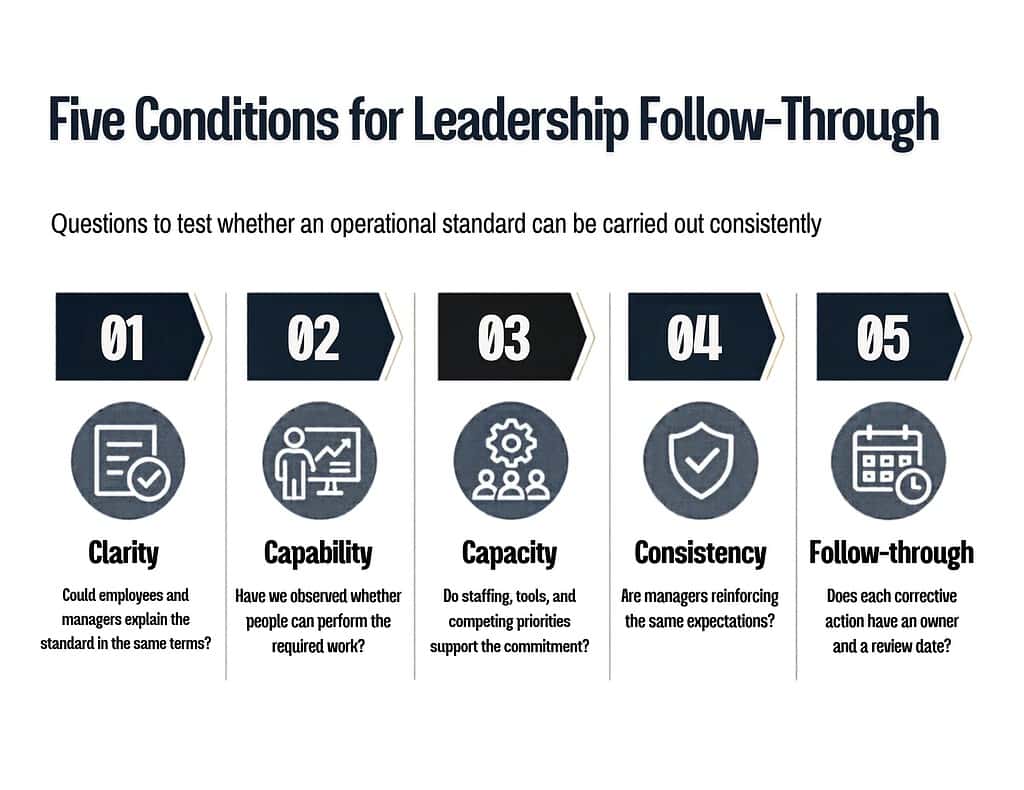
Use the answers to choose a specific action and identify the result it should influence.
For example, imagine customer requests repeatedly miss their SLA target because ownership is unclear during handoffs. The leadership action is to establish who accepts each request, what information must accompany it, and when unresolved work gets escalated.
The next step of your review is to examine whether handoffs follow the agreed process and whether overdue requests decline. If the process improves but outcomes don’t, investigate the next constraint. Completing the action is a milestone; improving the outcome remains the goal.
This approach also makes accountability fairer. People can see what they are expected to change, what leadership has committed to change, and how both will be evaluated.
Apply the standard to yourself first
Return to that weekly performance meeting. The dashboard may still be red. Difficult conversations may still be needed.
But the conversation becomes more useful when leaders can name their own commitments alongside the team’s expectations.
Instead of saying “We need to improve results,” try “We have identified the process causing the performance gap. I own defining clear authority and decision-making boundaries, and will review in next week’s meeting.”
Now you are giving a commitment people can act on and assess.
Operational excellence starts when leaders hold themselves to the same standards they hold everyone else: clear commitments, measurable progress, and consistent follow-through.
Care for people means preparing them to succeed and addressing the conditions that get in their way. Setting the standard means making expectations clear and applying them consistently. Owning the outcome means examining your contribution when results fall short.
If you want a more accountable operation, start by making leadership accountability visible.