

An operational framework for transforming prospecting data into sustainable revenue-generating capacity.
Prospecting data readiness is a critical operational
dependency for sustainable pipeline generation. The Six
Pillars of Prospecting Data Readiness provide a structured
framework for ensuring that sales development teams have
qualified, sufficient, relevant, validated, accessible,
and sustainable prospecting opportunities.
Organizations frequently confuse the successful
delivery of data with the successful delivery of
commercial opportunity. Without formal quality gates,
readiness metrics, and accountable ownership,
preventable data deficiencies consume selling
capacity and undermine revenue performance.
Treat prospecting data as a strategic operational
asset. Assess readiness across all six pillars,
establish pre-production acceptance standards,
implement proactive replenishment, and extend
accountability upstream. Measure the conditions
that enable performance, not just performance itself.
The Executive Brief
60-Second Read
The Bottom Line
The Uncomfortable Truth
The Leadership Imperative
Operational excellence begins long before the frontline starts execution.
In manufacturing, raw materials are inspected before entering production. Financial services pass transactions through internal controls. In workforce management, staffing decisions are informed by anticipated demand and historical KPIs.
Yet in sales development, one of the most consequential inputs into the revenue engine is frequently introduced into production without comparable operational discipline.
Prospecting data.
Organizations acquire it, import it, distribute it, and expect their sales development representatives to transform it into revenue.
When that doesn’t happen, scrutiny typically falls on the people responsible for executing the strategy rather than the processes that enable it.
In my previous article, Your SDR Team Doesn’t Need More Activity. It Needs a Better List, I challenged the industry’s obsession with activity and examined the financial, operational, and human consequences of inadequate prospecting data.
Recognizing the problem, however, is only the beginning.
Revenue leaders need a structured methodology to ensure their sales development operations are equipped to deliver the outcomes expected of them.
That methodology begins with prospecting data readiness.
Stop Treating Prospecting Data as an Administrative Deliverable
According to SDR Leaders Global’s The State of Sales Development 2026, SDR teams source an average of 50% of company pipeline across responding organizations.
Consider the significance of that finding.
For the average organization in the study, approximately half of its pipeline originates from a function whose effectiveness depends, in part, on the relevance, accuracy, sufficiency, and accessibility of its prospecting data.
Yet how often do organizations establish formal acceptance standards for the data entering their revenue engine?
A data team delivers thousands of records. A CRM administrator imports the records. A commercial stakeholder confirms that additional contacts have been supplied.
Everyone has completed their assigned task.
But has the organization actually increased its revenue-generating capacity?
There is a fundamental difference between delivering data and delivering opportunity.
The successful completion of an administrative task should never be confused with the successful delivery of a business outcome.
Prospecting data readiness is the degree to which an organization’s available account and contact universe is qualified, accessible, sufficient, and sustainable enough to support its intended commercial objectives.
It requires looking beyond record counts and populated fields to determine whether the data can reasonably support the work it was acquired to enable.
The Six Pillars of Prospecting Data Readiness
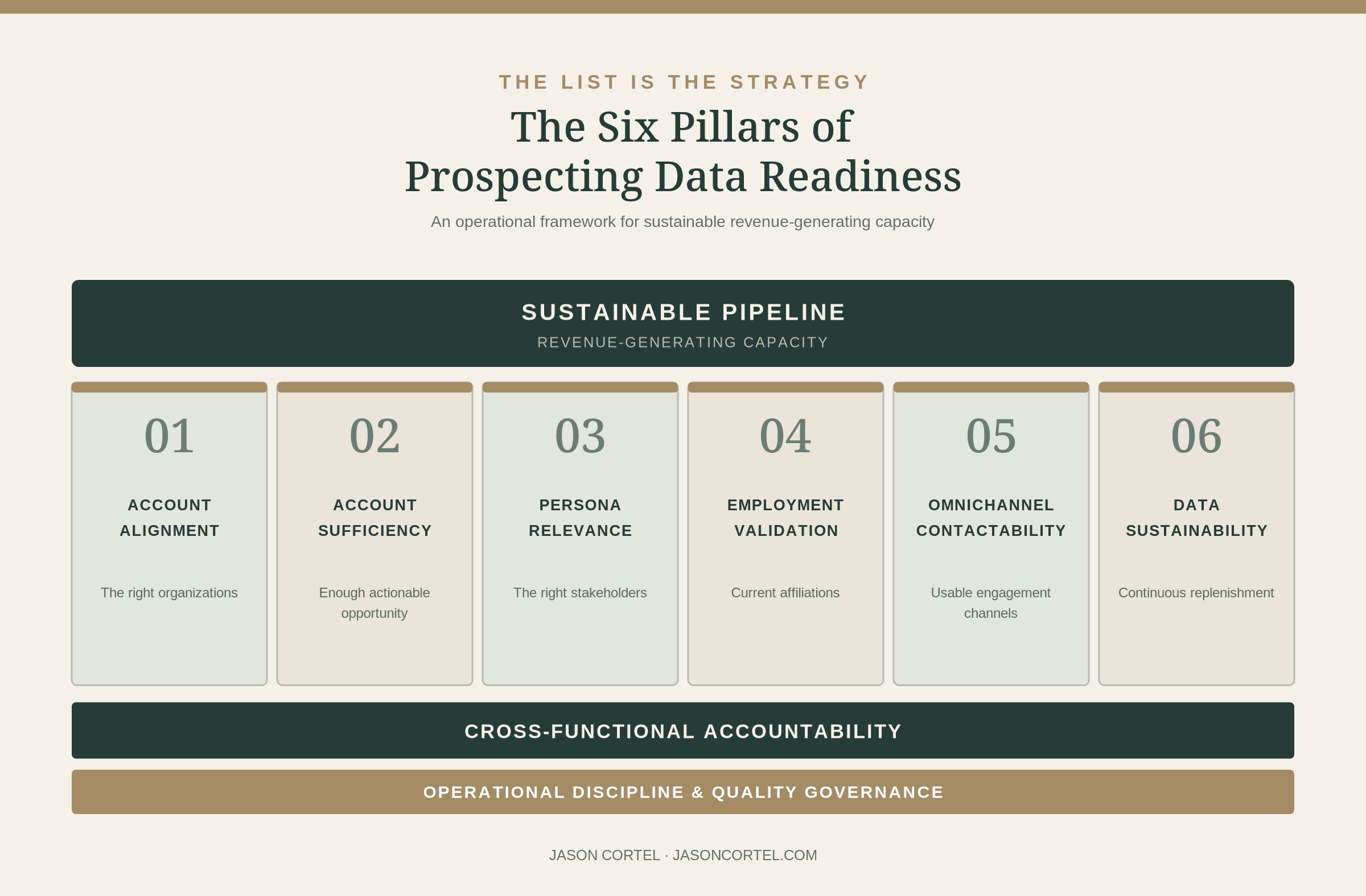
I propose six foundational pillars that revenue and operations leaders can use to evaluate, develop, and sustain a sales-ready prospecting strategy.
Each pillar addresses a distinct operational dependency. Together, they provide a framework for strengthening the infrastructure upon which sales development performance depends.
Pillar 1: Account Alignment
Are we pursuing the right organizations?
Every prospecting strategy should begin with a clearly articulated ideal customer profile (ICP).
Industry, organizational size, geography, revenue, technology environment, and relevant business characteristics should inform account selection.
However, account qualification must go beyond broad demographic alignment.
An organization may check the boxes for the general parameters of an ICP while lacking the operational environment, business challenge, or use case needed to qualify it as a prospect.
A poorly defined ICP creates ambiguity. Poorly enforced ICP criteria transforms that ambiguity into revenue waste.
Establish and document account qualification criteria, exclusion rules, required attributes, and procedures for resolving uncertain classifications.
What to measure: Account alignment rate, disqualification rate, and the completeness of required account attributes.
Just because an account exists doesn’t necessarily mean it can convert.
Pillar 2: Account Sufficiency
Is there enough actionable opportunity to support the goals?
Account sufficiency is one of the most frequently overlooked dependencies in sales development.
Organizations establish meeting expectations, staffing models, and commercial commitments without adequately validating whether the available prospecting universe can support them.
Leverage historical performance data to determine the account requirements such as conversion rates, meeting attendance, contactability, outreach cadence, account saturation, and available selling capacity.
Consider an SDR expected to deliver 30 held meetings per month.
Assuming a 75% meeting show rate and an expected monthly yield of four booked meetings per 100 actionable accounts, the operation would require approximately 1,000 actionable accounts per SDR.
These assumptions aren’t industry benchmarks. Every organization has its own model using historical trends.
The distinction between assigned accounts and actionable accounts is particularly important. Exhausted, disqualified, suppressed, or otherwise unavailable accounts should not be treated as equivalent to legitimate prospecting opportunities.
What to measure: Workable accounts per SDR, account saturation, and expected account penetration and degradation.
Before setting expectations for the front line, reconcile performance commitments with operational capacity.
Pillar 3: Persona Relevance
Are we engaging the people who matter?
An organization can be perfectly aligned with the ICP while its associated contacts are completely irrelevant to the solution being represented.
Job titles alone are insufficient indicators of buying relevance.
Organizations must understand the buying committee, including decision-makers, technical evaluators, influencers, internal champions, and other stakeholders with a legitimate connection to the business problem.
Define relevant personas by functional responsibility, organizational influence, seniority, and potential involvement in the purchasing process.
The goal is to populate accounts with the right contacts, not to fill in space with any random contact.
Expecting SDRs to work across unrelated departments to find appropriate decision-makers will not create a successful sales development program.
What to measure: Persona alignment rate, relevant contacts per account, and buying committee coverage.
A contact should represent a valid commercial opportunity, not merely another record available for activity.
Pillar 4: Employment Validation
Are the people we intend to engage still there?
People change jobs. Organizations restructure. Responsibilities evolve. Companies merge, close, and eliminate departments.
A contact record that was accurate six months ago may be completely irrelevant today.
Employment validation must therefore be an ongoing operational responsibility, not a one-time data-cleansing exercise.
Organizations should establish standards for confirming organizational affiliation and functional responsibility, supported by periodic reviews.
Records with unverified organizational affiliation should be clearly distinguished from recently validated contacts.
SDRs should contribute intelligence gathered through legitimate prospecting conversations, but they should not become profiliers who validate data..
What to measure: Employment validation rate, outdated contact rate, and contact verification age.
Historical accuracy doesn’t always translate to present-day relevance.
Pillar 5: Omnichannel Contactability
Can we connect with the people we intend to engage?
Modern sales development depends on engaging relevant stakeholders across multiple communication channels.
Despite the evolution of digital outreach, the telephone remains a consequential part of that strategy. The State of Sales Development 2026 found that 72% of responding organizations identified the phone as their leading pipeline-generating channel.
That makes prospecting data quality a priority, not a secondary consideration.
A sales-ready contact record should provide practical, appropriately sourced, and usable engagement channels, which may include:
- Valid mobile numbers.
- Valid direct dial numbers.
- Accurate corporate numbers.
- Valid email addresses.
- Current social profiles.
Each channel has a different value. A corporate number should not be treated as equivalent to a verified direct dial or mobile.
Likewise, an email address in a field does not guarantee deliverability, and a social profile does not necessarily provide an accessible outreach channel.
All contact acquisition, validation, and outreach must comply with applicable privacy laws, communication requirements, and organizational policies.
What to measure: Direct and mobile number coverage, email deliverability, channel accessibility, and the percent of relevant contacts with usable engagement channels.
A database can be complete on paper and commercially inaccessible in practice.
Pillar 6: Data Sustainability
Can the prospecting universe support performance over time?
Even an exceptionally qualified prospecting list will deteriorate.
Accounts become exhausted. Contacts change roles. Telephone numbers become invalid. Market conditions evolve. New opportunities emerge.
The initial delivery of a prospecting list should therefore be viewed as step one of many in ongoing data management.
Organizations must establish processes for continuous validation, replenishment, deduplication, account recycling, and saturation management.
Replenishment requirements should be informed by anticipated demand and historical account consumption, not the urgency of the latest escalation from sales development leadership.
Waiting until SDRs have exhausted their prospecting universe before acquiring additional data is not a replenishment strategy.
It is reactive management.
What to measure: Account replenishment rate, actionable account inventory, validation recency, and projected time until account depletion.
Sustainable pipeline generation requires a sustainable supply of qualified prospecting opportunity.
Introduce Quality Gates Before Data Enters Production
The Six Pillars of Prospecting Data Readiness establish what organizations should evaluate. Quality gates determine whether the data is ready to be released into production.
A quality gate is a checkpoint where a deliverable is assessed against acceptance criteria before advancing to the next stage of a process.
Manufacturing operations would not knowingly introduce defective materials into production and expect frontline employees to compensate indefinitely for those deficiencies.
Sales development deserves comparable rigor.
A prospecting data acceptance process should incorporate the following controls.
| Quality Gate | Acceptance Requirement |
| Account qualification | Alignment with the approved ICP and exclusion criteria. |
| Account sufficiency | Available workable volume supports the intended goals. |
| Persona qualification | Contacts align with approved buying roles and functional responsibilities. |
| Employment verification | Reasonable evidence of current organizational affiliation. |
| Channel validation | Usable contact information appropriate to the outreach strategy. |
| Data integrity | Required fields, deduplication, consistent formatting, and applicable suppression checks. |
| Human quality review | Representative inspection for contextual defects automated processes may miss. |
| Production approval | Confirmation that established acceptance standards have been satisfied. |
The organization should establish its own acceptance thresholds based on market conditions, commercial requirements, historical results, and regulatory obligations.
Records that fail to satisfy critical requirements should be rejected, corrected, or quarantined rather than automatically released into production.
An exception process may be necessary in certain markets, but exceptions should be deliberate, documented, and understood by the stakeholders accountable for performance.
The objective is not to create unnecessary hurdles. It is to prevent downstream rework.
Every preventable defect eliminated before production represents time the SDR doesn’t spend correcting it.
Use AI to Improve the Inputs, Not Just Accelerate the Outputs
Much of the conversation surrounding artificial intelligence in sales development focuses on increasing outbound activity.
Automated prospecting, messaging, personalization, and engagement.
Another compelling opportunity deserves more attention.
Using AI to improve the quality of the prospecting infrastructure itself.
The 2026 State of Sales Development report recommends extending AI across a broader range of workflows, including research, data review, list development, and ICP development.
These use cases deserve serious consideration.
AI can help identify persona mismatches, classify job responsibilities, enrich account profiles, and prioritize data requiring further inspection.
However, an AI-generated classification can’t be treated as verified fact.
Human oversight, validation sources, data governance, and measurable accuracy requirements remain a top priority.
Just because an automated process completes the task faster and imports thousands of irrelevant contacts doesn’t make it an operational improvement.
Automation without quality control is a mechanism for scaling defects.
The objective is to reduce preventable friction throughout the revenue engine, not to increase the speed of completing tasks.
Accountability Must Extend Upstream
Prospecting data readiness can’t become another responsibility that falls exclusively on the SDR manager.
Sales development is a cross-functional operation. Its governance should reflect that reality.
Each function contributing to the commercial outcome should have clearly defined responsibilities.
| Function | Primary Accountability |
| Commercial leadership | Operationally achievable commitments and clearly defined commercial requirements. |
| Data operations | Accurate, relevant, validated, and sufficient prospecting data. |
| Revenue operations | Integrated systems, process controls, reliable reporting, and data governance. |
| Client success | Stakeholder alignment, expectation management, and dependency resolution where applicable. |
| Sales development leadership | Resource deployment, coaching, execution, performance feedback, and optimization. |
| Sales development representatives | Quality outreach, meaningful engagement, qualification, and prospecting intelligence. |
| Executive leadership | Cross-functional alignment, resource allocation, and resolution of systemic barriers. |
The exact ownership structure varies by organization, but the principle still applies.
Accountability follows the dependencies that enable revenue performance.
Shared accountability does not mean diluted accountability. It means holding each function responsible for the component of performance it controls acctounable.
If data quality degrades, there should be an owner, a remediation process, and a resolution timeline to have true accountability.
The SDR isn’t the shock absorber for every upstream failure.
Measure What Enables Performance, Not Just Performance Itself
Standard revenue dashboards tend to focus on outcomes.
Meetings booked and held. Opportunities created and pipeline generated. Closed-Won contributions.
These measures are necessary, but they are lagging indicators of decisions and activities occurring throughout the sales development operation.
Organizations should introduce operational readiness indicators that provide earlier visibility into the conditions supporting performance.
The following measures provide a practical starting point.
| Readiness Indicator | Calculation |
| Account alignment rate | ICP-aligned accounts ÷ accounts reviewed |
| Account capacity coverage | Available actionable accounts ÷ required actionable accounts |
| Persona alignment rate | Relevant contacts ÷ contacts reviewed |
| Employment validation rate | Currently validated contacts ÷ contacts reviewed |
| Omnichannel contactability rate | Relevant contacts with usable outreach channels ÷ relevant contacts reviewed |
| Account replenishment ratio | New actionable accounts added ÷ accounts removed from actionable inventory |
Evaluate these indicators alongside execution metrics such as meaningful conversations, response rates, conversion rates, meeting attendance, and pipeline generation.
The relationships between these measures reveal important troubleshooting signals.
High activity with declining conversations may indicate deteriorating data quality or persona mismatch.
Increasing account saturation accompanied by a lack of data refresh may signal an emerging capacity problem.
Strong contactability accompanied by weak conversation-to-meeting conversion may warrant closer examination of messaging, qualification levels, training, or coaching.
These relationships alone don’t establish causation. They provide leaders with a more informed starting point for inspection.
The objective is to manage the conditions that enable performance rather than merely reacting when performance falls short.
Conduct a Prospecting Data Readiness Assessment
Start implementing the framework by conducting an initial assessment across all six pillars.
Evaluate each pillar using a five-point maturity scale.
| Score | Maturity Level | Description |
| 1 | Reactive | No defined standards, inconsistent execution, and limited visibility. |
| 2 | Emerging | Basic processes exist, but execution and ownership remain inconsistent. |
| 3 | Defined | Documented standards, assigned ownership, and repeatable processes. |
| 4 | Managed | Performance is measured, monitored, and proactively corrected. |
| 5 | Optimized | Continuous improvement, predictive planning, and integrated cross-functional governance. |
The assessment produces a combined score between six and 30.
However, leaders should resist the temptation to allow a strong aggregate score to conceal a critical operational deficiency.
An organization may have excellent account alignment and employment validation but insufficient actionable accounts to support its performance expectations.
The other pillars can’t compensate for that shortage.
I recommend examining both the overall maturity score and the lowest individual pillar score.
Any pillar rated one or two triggers a documented improvement initiative. Critical failures, including compliance violations or data that cannot support its intended use, should be escalated regardless of the aggregate score.
This assessment is a proposed management tool, not a statistically validated industry benchmark. Its primary value is in creating visibility, establishing priorities, and tracking operational improvement over time.
A 90-Day Plan for Improving Prospecting Data Readiness
Organizations don’t need an enterprise-wide transformation to start implementing these principles.
A focused 90-day initiative can establish the foundation for a more disciplined prospecting data operation.
Days 1–30: Diagnose
Establish the current state of the prospecting universe.
- Assess all six pillars.
- Audit a representative sample of accounts and contacts.
- Compare available actionable accounts with performance requirements.
- Quantify time wasted on preventable data remediation.
- Identify critical dependencies and assign accountable owners.
The objective is to replace assumptions with operational visibility.
Days 31–60: Stabilize
Address gaps that create the greatest performance inhibitors.
- Remediate critical account and contact defects.
- Establish formal data acceptance standards.
- Introduce pre-production quality gates.
- Implement readiness metrics and regular reporting.
- Develop an account replenishment plan.
The goal here is to contain existing defects while preventing new ones from entering production.
Days 61–90: Optimize
Transition from reactive remediation toward sustainable operational management.
- Establish cross-functional readiness reviews.
- Monitor data consumption and replenishment requirements.
- Evaluate opportunities for AI-assisted validation.
- Reassess all six pillars.
- Compare readiness improvements with execution efficiency and commercial outcomes.
The goal is to establish an ongoing operating discipline rather than complete another temporary improvement project.
From Data Delivery to Revenue Enablement
The organizations that develop stronger sales development operations will not necessarily be those that acquire the most data, implement the most technology, or demand the highest activity levels.
They will be those that understand how to convert resources into meaningful commercial opportunity.
That requires a fundamental shift in how prospecting data is managed.
From acquisition to qualification.
Switch from record volume to actionable opportunity.
From reactive replenishment to sustainable capacity.
From departmental task completion to cross-functional accountability.
Sales development data quality can’t be relegated to administrative conversations occurring far removed from executive discussions about pipeline, productivity, and revenue performance.
It belongs in those discussions.
Operational excellence isn’t achieved by flogging frontline employees until they overcome every inadequacy in the systems designed for them.
It is achieved by designing systems that make exceptional performance possible, establishing standards that protect those systems, and holding every contributing function accountable for its responsibilities.
The list is not something your SDRs simply receive before beginning their work.
It is one of the most consequential operational assets your organization provides them.
The list is the strategy. Build it with the same discipline, intentionality, and accountability you expect from the people responsible for executing it.
About The List Is the Strategy Series
This article is the second installment in The List Is the Strategy, an executive thought leadership series examining the relationship between prospecting data, operational excellence, sales development productivity, and sustainable pipeline generation.
Read the first installment: Your SDR Team Doesn’t Need More Activity. It Needs a Better List.